

How To Play Ff7 Before Crisis
| Before Crisis: Concluding Fantasy VII | |
|---|---|
 The logo of Before Crisis: Terminal Fantasy VII as designed for the original FOMA release. | |
| Developer(s) | Square Enix |
| Publisher(s) | Square Enix |
| Manager(due south) | Hajime Tabata |
| Producer(s) | Yukimasa Ito |
| Artist(due south) | Tetsuya Nomura |
| Writer(s) |
|
| Composer(s) | Takeharu Ishimoto |
| Series | Compilation of Concluding Fantasy VII Terminal Fantasy |
| Platform(s) | Mobile |
| Release | FOMA
|
| Genre(s) | Activity function-playing game |
| Fashion(s) | Single-actor, multiplayer |
Before Crunch: Terminal Fantasy VII [a] is an activeness part-playing video game adult past Square Enix and originally released for the FOMA mobile service on September 24, 2004. It was after released for SoftBank Mobile and EZweb in 2007. Before Crisis is a prequel to the 1997 video game Final Fantasy Seven and forms part of the Compilation of Final Fantasy Seven, a metaseries expanding on and continuing the story established in Final Fantasy VII. Information technology takes place six years prior to the events of Final Fantasy VII and focuses on the adventures of the Turks, a group of covert operatives working for the Shinra Electric Power Company, and their fights against both insubordinate group AVALANCHE and their corrupt employers.
As the first major Terminal Fantasy game for mobile devices, Before Crisis was designed as a gameplay and multiplayer experience unique to the platform. Information technology is the first major project directed past Hajime Tabata, who created the initial concept at the request of Tetsuya Nomura for a game that had the Turks as protagonists. The music was equanimous by Takeharu Ishimoto, originally a sound arranger at Square Enix. It was highly successful upon release, registering 200,000 users and existence accessed over ane million times. Western critics accept more often than not praised the championship, just due to issues involving the capacity of mobile devices in the due west, it has not been released outside Nippon. The game was eventually close down in 2018.
Gameplay [edit]
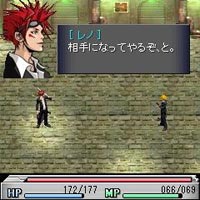
A screenshot of Before Crunch showing one of the playable characters (right) and the on-screen brandish.
Before Crisis is a real-time action office-playing game featuring 2D graphics every bit the player moves forth in a side-scrolling manner.[two] The player begins the game by selecting their character, which tin can exist a man or a woman, along with their name.[three] Gameplay is divided up between several modes of play. "Episode Mode" involves the player playing through the game's main storyline, completing various objectives in social club to continue on in the game. "Free Fashion" allows players to roam towns and speak with the population. Players can besides play actress missions to proceeds Experience points and items, some of which are exclusive to "Complimentary Manner".[2] Characters take hit points and magic points, and tin level up upon conquering of experience, at which point they can equip new weapons and armor.[2] Players can choose to manually attack an enemy during combat or printing the activity key to automatically attack the nearest enemy.[4]
The "Materia Generation System" allows players to acquire Materia, objects tied to the game's magic system, by taking a picture with their camera telephone. The game synthesizes the picture down to its base color. Depending upon the dominant colour, lighting, and other factors, the game produces a Materia of a certain blazon. For example, a dark green film results in a Bio Materia, while a blue picture results in a Cure Materia. Once acquired, Materia can be leveled up as in Final Fantasy Vii.[ii] Nether certain circumstances, assistance in the grade of summoned monsters, recurring figures in the Terminal Fantasy series, tin can be chosen in via the Materia system to bargain impairment to multiple enemies.[5] Rank Points are awarded during the completion of objectives in all three modes of play. After a certain number of Rank Points have been acquired, special bonuses are unlocked, such every bit stronger armor and weapons, and extra Materia slots. The role player is as well given a rank, based upon how long they have been playing the game. The higher their rank, the better the bonuses the player gets.[5] [vi] [7]
The game uses an ad hoc online multiplayer feature that enables various deportment between players, including trading Materia via electronic mail.[2] [8] Players can summon a friend to cast magic by filling the "Materia aid" meter.[9] Up to three players can team up at any one time.[x] "Rescue Fashion" is activated if the player is defeated during "Episode Fashion", at which bespeak they accept the choice to restart and lose points, or allow themselves to be imprisoned and wait for other players to rescue them. The player can be rescued while their phone is powered downwardly.[eleven]
Additions were made after the initial release. In 2006, a fighting loonshit dubbed "Battle Square" was added. In the "Battle Foursquare", players can either fight other players or AI-controlled enemy units. Victory is adamant by which side defeated the other and impairment taken during gainsay. In "Battle Tournament" mode, players can choose to employ a handicap: the handicap is determined randomly by a materia slot.[12] [13] [fourteen] Two actress difficulty settings were besides added, with players able to switch between these and the normal difficulty in the game card. "Easy Mode" was released in 2006 and allows the actor to auto-evade incoming attacks and reduce damage taken, while "Difficult Mode", released in 2007 and meant for advanced users, increases the damage dealt by enemy attacks.[xv] [16]
Synopsis [edit]
Setting and characters [edit]
Before Crisis is fix half-dozen years prior to the events of Final Fantasy VII. The world on which Before Crisis is set, called "the Planet" in-game and "Gaia" by game staff,[17] is divided into multiple regions run by a megacorporation called the Shinra Electrical Ability Company. Shinra uses the free energy of the Planet, known as the Lifestream, to power the world, and as such is endangering the Planet and its people. The events of Before Crisis frequently overlap with those of Crisis Core: Concluding Fantasy VII. The verbal setting is shortly after the end of a war between Shinra and the people of Wutai. With Wutai defeated, and the people of the earth at present dependent on Shinra's free energy, the visitor becomes the dominant economic, war machine, and political power in the world. Rising against them is Barrage, a insubordinate grouping who rightly believe that Shinra'south energy extraction is slowly killing the planet.
The playable characters and main protagonists are the Turks, a group of covert operatives working for Shinra. The playable characters in-game are eleven new Turks: 10 of them are designated past their weapon or fighting way and their gender, while the eleventh is known as Legend (Male). Their name can be selected past the actor. One of the characters, Shuriken (Female), later appears in Crisis Core: Concluding Fantasy Vii under the proper noun "Cissnei". The Turks are led by Veld, a veteran of the group, and later Tseng, a grapheme who plays an important office in other Final Fantasy 7 stories. Their primary antagonists all belong to AVALANCHE. The iii of import Barrage characters are Elfé, the leader of Barrage and Veld's daughter; Fuhito, a scientist who acts as the planner for the grouping; and Shears, Avalanche's second-in-command. Multiple characters from Final Fantasy VII make appearances either as cameos or supporting characters, such equally protagonists Cloud Strife, Tifa Lockhart, Aerith Gainsborough and supporting character Zack Fair, equally well as antagonists Rufus Shinra, son of the company president, and Sephiroth, a SOLDIER who would go rogue.
Plot [edit]
Before Crisis opens with the trainee Turks on a mission in the city of Midgar to investigate AVALANCHE activities. With help from Reno, Avalanche retreat. However, the attack proves to be a diversion for a greater strike at the boondocks of Junon, where President Shinra is ready to give a speech communication. President Shinra is shot, just survives, and calls in Sephiroth. However, it transpires that fifty-fifty the attack on the President was a diversion, and AVALANCHE's real target was a weapon called the Mako Cannon, which they planned to burn down at Midgar, destroying the city. Elfé and Sephiroth practise battle at the cannon, but the fight ends inconclusively, and Avalanche withdraw. Barrage adjacent target Rayleigh, a professor carrying information on the SOLDIER members and their creation. The Turks are sent to protect Rayleigh, accompanied by several Shinra guards, including Deject. Fuhito, a scientist working for Avalanche, is able to decadent Rayleigh's data when the Turks disobey orders and relieve Rayleigh instead of protecting the information. Using the SOLDIER information, Fuhito develops an elite unit of measurement known as the Ravens, using them to capture 2 SOLDIERs, Essai and Sebastian. The Turks succeed in rescuing the pair, and are then sent to destroy AVALANCHE, accompanied by Zack. Essai and Sebastian, however, are captured once once again, and turned into Ravens. Even though Zack is able to bring them back to their senses, he is unable to save them.
Meanwhile, President Shinra becomes suspicious of the Turks' activities, believing that someone within the organization is leaking sensitive information. He concludes that it must be Veld, and removes him from command, instead placing the company's security leader Heidegger in charge. In his first operation however, Heidegger nearly destroys Junon, and the President reinstates Veld. In his first mission back in command, Veld plans to defeat Barrage. An assault is launched at a Mako Reactor, during which Rufus Shinra is revealed to be the traitor supporting AVALANCHE. He is captured past the Turks and placed under house abort. At the same time, Shears defects to the Turks in an effort to salve the gravely ill Elfé. Veld discovers that Elfé is his daughter Felicia, whom he thought dead in a botched Shinra operation, and resigns from the Turks. With Elfé standing to weaken, Fuhito takes over the command of Barrage. It is revealed that a Materia owned by Elfé is Zirconiade, an ancient and powerful summoned monster that Fuhito intends to utilize to destroy humanity and end them harming the planet. Withal, the Materia is broken, and is slowly draining Elfé's life energy. To save her, the 4 Back up Materia must be found. Fuhito holds 1, and the Turks and Shears hold some other.
Meanwhile, not wanting Rufus' betrayal become known, the President orders the Turks' devastation. Despite this imminent threat, the Turks manage to find two more Support Materia. Under Fuhito's control, the remainder of AVALANCHE is turned into a vicious regular army of uncontrollable Ravens, and he manages to steal all the materia needed. In the final battle, Fuhito summons Zirconiade, fusing the summon with his own body, and Shears sacrifices himself to save Elfé. Fuhito transforms into a monster, merely he is defeated past the Turks. After the battle, Tseng falsely claims that both Veld and Elfé are dead, and so equally to protect them from being hunted by Shinra. The Turks are then reorganized, with Tseng reinstated as their immediate leader, only they are now sworn to loyalty to Shinra as office of the deal for their survival. The original Turks notice new lives for themselves in hiding, and are later seen helping in the evacuation of Midgar during the events of Final Fantasy VII.
Evolution [edit]
Before Crisis was created as function of the Compilation of Last Fantasy 7, a multimedia serial based in and on the world and characters of Concluding Fantasy 7. While the film Last Fantasy 7: Advent Children was originally to be the only production of the Compilation, the product team agreed that one title was not enough to explore the world of Final Fantasy VII in full, so more titles were decided upon, including Dirge of Cerberus: Final Fantasy Vii and Crisis Cadre.[18] Before Crisis was originally conceived by Tetsuya Nomura, 1 of the artistic minds behind Terminal Fantasy VII and the Compilation.[17] His initial thought was simply for a mobile action part-playing game using the mobile network. During pre-production, it was decided to set it within the world of Final Fantasy VII. Hajime Tabata joined at this point.[eleven] He approached Tabata, who had only recently joined the company'due south mobile games segmentation, and asked if the sectionalisation could create a mobile game focused on the Turks. Nomura would end up designing the game's characters.[nineteen] Production began in 2002. Information technology was worked on by a core team of 18 people. Staff from the original game took supervisory roles.[eleven] [17] The game's title was thought up by Tabata, and would proceed to plant a organization of letter of the alphabet-based abbreviations used by staff for titles in the Compilation.[20] To assistance solidify their goal, the staff created a timeline for the globe of Final Fantasy Seven. Since at that place was lilliputian definite information concerning events prior to Terminal Fantasy 7, they had a relative amount of creative liberty, including creating an early, more than violent incarnation of insubordinate grouping Barrage.[17] Although Before Crisis is the 2nd title created for the serial, it was the first to be released because Advent Children was delayed during post-production.[21]
Before Crisis was the first original video game adult past Square Enix exclusively for mobile phones, originally released on NTT DoCoMo'south FOMA mobile devices, and the offset action role-playing game exclusive to the platform.[11] [22] [23] The company's get-go major mobile title, also in collaboration with NTT DoCoMo, was a remake of the original Last Fantasy. Using lessons learned from the development of the Final Fantasy port, the team worked hard to make Before Crunch a uniquely mobile experience, with gameplay features congenital to exploit mobile functions such as the camera and network chapters.[23] The camera role used to generate Materia was based on a uncomplicated image recognition that specifies the Materia generated based on the picture's general color.[23] One of the challenges during development was to keep the framerate shine during moments of high activeness, particularly every bit no two mobiles would have identical components.[17] In addition to these problems were problems with integrating the multiplayer functions, balancing the gameplay for different playstyles, creating a comfy button layout, and adjusting the amount of content they could include for mobiles while maintaining the desired product quality.[11]
To promote the game, Madhouse created a promotional blitheness featuring some of the main characters.[24] The original version's beta examination started in August 2004.[2] It was released on September 24.[5] Following an announcement at the Tokyo Game Show in 2006, the game was released for two boosted Japanese mobile carriers. It was respectively released for SoftBank Mobile and EZweb on January 30 and April 5, 2007.[25] [26] New logos were created for each release.[27] In 2010, Tabata voiced an involvement in fully remaking Before Crunch for the Nintendo 3DS, revamping the narrative delivery and incorporating the ability for a substantial number of players to enter missions. This suggestion was positively received by Nomura and Yoshinori Kitase, but at the time Tabata was busy developing Final Fantasy Type-0 (then Agito XIII) and The third Birthday.[28] Deployment for the SoftBank version ended in June 2015.[29] All versions of the game concluded with Foursquare Enix's old mobile services were shut down in 2018.[30]
Music [edit]
The composer for Earlier Crisis was Takeharu Ishimoto, who would continue to compose music for Crisis Core. Originally joining the company equally a music arranger, he was 1 of many staff who participated in a contest set by the game developers to find a composer for Before Crunch. His task was to create a piece of music that was related to the earth of Final Fantasy VII, simply yet distinctive. It was one of Ishimoto'southward first jobs equally the main composer for a championship.[31] The music of Before Crisis was commercially released along with the music from the original video animation Last Order: Final Fantasy Seven in an album titled Before Crisis: Last Fantasy 7 & Concluding Lodge: Final Fantasy Seven Original Soundtrack. The majority of the tracks of the anthology were composed by Ishimoto, apart from a few reorchestrated themes from VII, the music of which was written by regular Final Fantasy composer Nobuo Uematsu.[32]
Localization [edit]
The game'due south release in the due west was announced at the 2006 Electronic Entertainment Expo, ii years afterwards its release in Nippon. At the announcement, the localization was said to be "coming along nicely."[33] The stated reason for the delay betwixt the original and projected western release was that mobile phones in the west were not yet advanced enough for the game.[34] One of the things planned for the western release was to bring the entire experience over as speedily as possible, with plans for i to 3 chapters released each month, and fine-tuning to exist done using the planned ii-twelvemonth gap between the original and western releases. Information technology formed part of a push past the visitor into the western mobile game marketplace.[35] Despite these announcements, no further progress has been fabricated and Before Crisis was never released in the west. The official reason for this, as stated by head of mobile operations Keiji Fujita, was that mobile phones in the due west were too low-spec for Earlier Crunch, which could but run on high-terminate phones in Japan, making a port impossible. Some other possible reason suggested by Fujita was Ito's move from Foursquare Enix to Capcom in 2008, leaving no-i to manage any future localization and porting efforts.[36]
Reception [edit]
Japanese website ITmedia reviewed the beta version in September 2004. The reviewer enjoyed the experience overall and constitute communication with other players like shooting fish in a barrel, but establish a few faults with the game that they hoped would exist resolved later, and generally plant the female characters less effective in battle.[37] During its get-go mean solar day of performance, the game registered 200,000 users, making information technology the best-selling mobile game up until that time, and was accessed one.half-dozen million times.[35] [38] According to Ito, by 2006, the game was still highly popular in Nihon.[eleven]
Previews and features concerning the game have generally been positive. AnimeFringe commented that the visuals seemed "remarkable skillful" and praised the game for choosing to "reverse the practiced and bad guy roles," by making the Turks protagonists, and Barrage antagonists.[39] Cara Lee Haslam of RPGamer previewed the game at E3 2006 and stated that the "graphics are really cracking, especially for a jail cell phone game," although she also noted that the animation "isn't the best."[40] GameSpot'southward Bethany Massimilla likewise previewed the game at E3, calling it "perfectly digestible in delivery," with its use of episodic storytelling that comes in "small bursts in betwixt action periods." She also stated that the game had "well-defined and detailed grapheme portraits and lean, lanky character models running effectually the city and mako reactor, which had a uncomplicated layout just still looked dainty." Massimilla praised the smooth animations, and felt that "the controls were easy to learn and were responsive." Additionally, she thought the demo phone'southward vibrating function, set up off when the player receives a call from Tseng, was a subtle detail.[nine] Levi Buchanan of IGN was more often than not positive, praising the nighttime art manner, and finding the short mission-based structure platonic for mobile gameplay.[4] 1UP.com listed the game every bit ane of five classic Japanese mobile games unlikely to come up to North America.[22]
Exterior its firsthand reception, Before Crisis had an outcome on other projects within the Final Fantasy series. Later on the positive reception of Madhouse's animated commercial, they were chosen past Square Enix to animate Last Order.[24] The loftier popularity of Before Crunch in Japan led indirectly to the creation of Type-0, part of the Fabula Nova Crystallis Final Fantasy subseries and and so a title for mobiles.[41] [42] [43]
References [edit]
- Translation
- ^ Japanese: ビフォア クライシス -ファイナルファンタジーVII-, Hepburn: Bifoa Kuraishisu -Fainaru Fantajī Sebun-
- Citations
- ^ Winkler, Chris (Baronial 4, 2004). "Foursquare Enix Opens Before Crisis: Final Fantasy Vii Website". RPGFan. Archived from the original on September 5, 2015. Retrieved February 17, 2015.
- ^ a b c d due east f Gantayat, Anoop (August 31, 2004). "Easily On: Before Crisis Final Fantasy 7". IGN. Archived from the original on September 13, 2015. Retrieved December sixteen, 2014.
- ^ 「BC -FFVII-」第2章,10月16日配信開始! (in Japanese). ITmedia. Oct xv, 2004. Archived from the original on December 16, 2014. Retrieved December 16, 2014.
- ^ a b Buchanan, Levi (May ix, 2006). "E3 2006: Before Crisis Easily-On". IGN. Archived from the original on September 13, 2015. Retrieved December xvi, 2014.
- ^ a b c "BEFORE CRISIS -FINAL FANTASY VII- Index" (in Japanese). ITmedia. Archived from the original on May 14, 2007. Retrieved December 16, 2014.
- ^ スクウェア・エニックス サポートセンター. Square Enix. Archived from the original on January 26, 2015. Retrieved Jan 26, 2015.
- ^ スクウェア・エニックス サポートセンター. Square Enix. Archived from the original on Jan 26, 2015. Retrieved January 26, 2015.
- ^ "スクエニのネットワークアクションRPG「Before CRISIS」を解剖する" (in Japanese). ITmedia. September i, 2004. Archived from the original on April 24, 2014. Retrieved January 26, 2015.
- ^ a b Masimilla, Bethany (May 10, 2006). "E3 06: Earlier Crunch: Terminal Fantasy Vii Hands-On Impressions". GameSpot. Archived from the original on September xiii, 2015. Retrieved August 17, 2010.
- ^ Winkler, Chris (May 11, 2004). "E3: First Before Crunch - Final Fantasy VII Details Revealed". RPGFan. Archived from the original on September 8, 2015. Retrieved February 17, 2015.
- ^ a b c d e f Ito, Kosei (September 2005). "Mobile Postmortem; Earlier Crisis: Final Fantasy VII" (PDF). Game Programmer. UBM TechWeb. 12 (8): 28–33. Archived (PDF) from the original on March fifteen, 2014.
- ^ スクウェア・エニックス サポートセンター. Square Enix. Archived from the original on January 26, 2015. Retrieved January 26, 2015.
- ^ スクウェア・エニックス サポートセンター. Square Enix. Archived from the original on January 26, 2015. Retrieved January 26, 2015.
- ^ 「ビフォア クライシス -FFVII-」で「バトルスクェア」が正式オープン (in Japanese). ITmedia. April 28, 2006. Archived from the original on September 12, 2014. Retrieved February 3, 2015.
- ^ 「ビフォア クライシス -FFVII-」、難易度を下げたイージーモードが登場 (in Japanese). ITmedia. October 30, 2006. Archived from the original on Jan 26, 2015. Retrieved January 26, 2015.
- ^ 『BC-FFVII-』が各キャリア更新&フィギュア同梱ポーション発売 (in Japanese). Dengeki Online. Nov 27, 2007. Archived from the original on December 13, 2007. Retrieved January 26, 2015.
- ^ a b c d east "Interview: Kosei Ito Q&A" (in Japanese). ITmedia. 2004. Archived from the original on December 22, 2014. Retrieved December sixteen, 2014.
- ^ Stone, Cortney (September 1, 2005). "Kitase Discusses Compilation of Final Fantasy Seven". RPGamer. Archived from the original on December 11, 2014. Retrieved September 2, 2007.
- ^ Leo, Jon (November one, 2011). "Fantasy Star: Talking to Concluding Fantasy Scenario Director Hajime Tabata". GameSpot. Archived from the original on March 10, 2014. Retrieved July 13, 2014.
- ^ Studio BentStuff, ed. (September xiii, 2007). Final Fantasy Vii 10th Ceremony Ω (in Japanese). Square Enix. pp. viii–xiii. ISBN978-4-7575-2560-3.
- ^ Watanabe, Yukari, ed. (2006). Final Fantasy VII Advent Children – Reunion Files – (in Japanese). SoftBank. p. 74. ISBN4-7973-3498-iii.
- ^ a b Pereira, Chris (September 20, 2012). "Japanese Jail cell Phone Treasures: 5 Mobile Games Nosotros Won't Exist Seeing". 1UP.com. Archived from the original on March 4, 2016. Retrieved March 31, 2013.
- ^ a b c Ito, Kosei; Diamante, Vincent (March viii, 2005). "Postcard from GDC Mobile 2005: Final Fantasy for Mobile: A Case Written report". Gamasutra. Archived from the original on November 12, 2014. Retrieved December sixteen, 2014.
- ^ a b SoftBank, ed. (2006). Final Fantasy 7 Advent Children: Reunion Files (in Japanese and English). Foursquare Enix. pp. 94–95. ISBN4-7973-3498-3.
- ^ Yahoo!ケータイで『ビフォアクライシス-FFVII-』配信スタート (in Japanese). Dengeki Online. Jan 30, 2007. Archived from the original on June 21, 2015. Retrieved February 17, 2015.
- ^ 『ビフォアクライシス-FFVII-』がついにEZwebでも配信開始に! (in Japanese). Famitsu. April v, 2007. Archived from the original on July 6, 2007. Retrieved April 23, 2013.
- ^ スクエニのネットワークRPG「ビフォア クライシス-FFVII-」がYahoo!ケータイとEZwebに (in Japanese). ITmedia. September 22, 2006. Archived from the original on September thirteen, 2015. Retrieved Feb 17, 2015.
- ^ Pigna, Kris (September 30, 2010). "Square Enix Producer Mulls Before Crisis: Final Fantasy Vii 3DS Remake". 1UP.com. Archived from the original on October 5, 2015. Retrieved March 31, 2013.
- ^ Before Crisis: Final Fantasy Seven (in Japanese). Earlier Crisis: Last Fantasy 7 Official Website. Archived from the original on October xxx, 2015. Retrieved March 1, 2016.
- ^ 「ファイナルファンタジーモバイル」サービス終了のお知らせ(3/31) (in Japanese). Square Enix. March 31, 2018. Archived from the original on April 15, 2018. Retrieved Apr 28, 2018.
- ^ スクウェア・エニックスの異端児、石元丈晴氏に直撃ロングインタビュー (in Japanese). Famitsu. March 23, 2013. Archived from the original on April 4, 2013. Retrieved December xvi, 2014.
- ^ Gann, Patrick (March fourteen, 2008). "Before Crisis -Final Fantasy Seven- & Terminal Lodge -Last Fantasy 7- OST". RPGFan. Archived from the original on January 16, 2013. Retrieved July 29, 2008.
- ^ Palley, Stephen (November 1, 2011). "Final Fantasy Seven: Before Crisis bound for US mobiles". GameSpot. Archived from the original on December 16, 2014. Retrieved December 16, 2014.
- ^ Hong, Quang; Sheffield, Brandon (June eighteen, 2006). "Q&A: Kosei Ito Talks Mobile Terminal Fantasy". Gamasutra. Archived from the original on November 10, 2014. Retrieved December 16, 2014.
- ^ a b Buchanan, Levi (July 6, 2006). "Interview with Square Enix Mobile: Kosei Ito". IGN. Archived from the original on December 14, 2014. Retrieved August 11, 2006.
- ^ Spencer, Yip (April four, 2010). "Afterwards Foursquare Enix Announced It, What Ever Happened To Earlier Crisis: Terminal Fantasy 7?". Siliconera. Archived from the original on October xix, 2014. Retrieved April iv, 2013.
- ^ 話題の新作、「BEFORE Crunch」に挑む (in Japanese). ITmedia. September 17, 2004. Archived from the original on September eleven, 2014. Retrieved Feb 3, 2015.
- ^ Winkler, Chris (October 14, 2004). "Before Crisis: Final Fantasy VII Registers 200,000 Users on Mean solar day I". RPGFan. Archived from the original on September 6, 2015. Retrieved July 21, 2012.
- ^ Crocker, Janet; Smith, Lesley; Henderson, Tim; Arnold, Adam (December 2005). "The Legacy of Final Fantasy VII". AnimeFringe. Archived from the original on October 6, 2014. Retrieved August 17, 2010.
- ^ Haslam, Cara Lee (May 12, 2006). "E3 Impression Last Fantasy VII: Before Crisis". RPGamer. Archived from the original on Dec 13, 2014. Retrieved Baronial 17, 2010.
- ^ インタビュー"ファイナルファンタジーXIII". Dengeki Online. June 2, 2006. Archived from the original on September 27, 2013. Retrieved November 24, 2013.
- ^ Foursquare Enix Presents: DKΣ3713 Private Party 2008 - 参加者の声 : クリスタルを守る少年たちの. Famitsu PS3. Enterbrain (13): 29. Baronial 22, 2008.
- ^ Gantayat, Anoop (Jan 28, 2011). "Kitase and Toriyama Talk FFXIII-2 and Fabula Nova Crystallis". Andriasang.com. Archived from the original on June 29, 2014. Retrieved December 12, 2012.
External links [edit]
- Official website (in Japanese)
Source: https://en.wikipedia.org/wiki/Before_Crisis:_Final_Fantasy_VII
0 Response to "How To Play Ff7 Before Crisis"
Post a Comment